If you have ever tried a Japanese sunscreen after years of American ones, you probably noticed the difference within seconds: thinner texture, no white cast, nothing greasy left on your face. It is tempting to conclude that Japanese sunscreen is simply “better.”
I work in cosmetic product development in Japan, and my honest answer is a little more interesting than yes or no. Most of the difference comes from how the two countries regulate sunscreen, which in turn decides which UV filters formulators are allowed to use and how quickly new ones reach the shelf.
The short answer
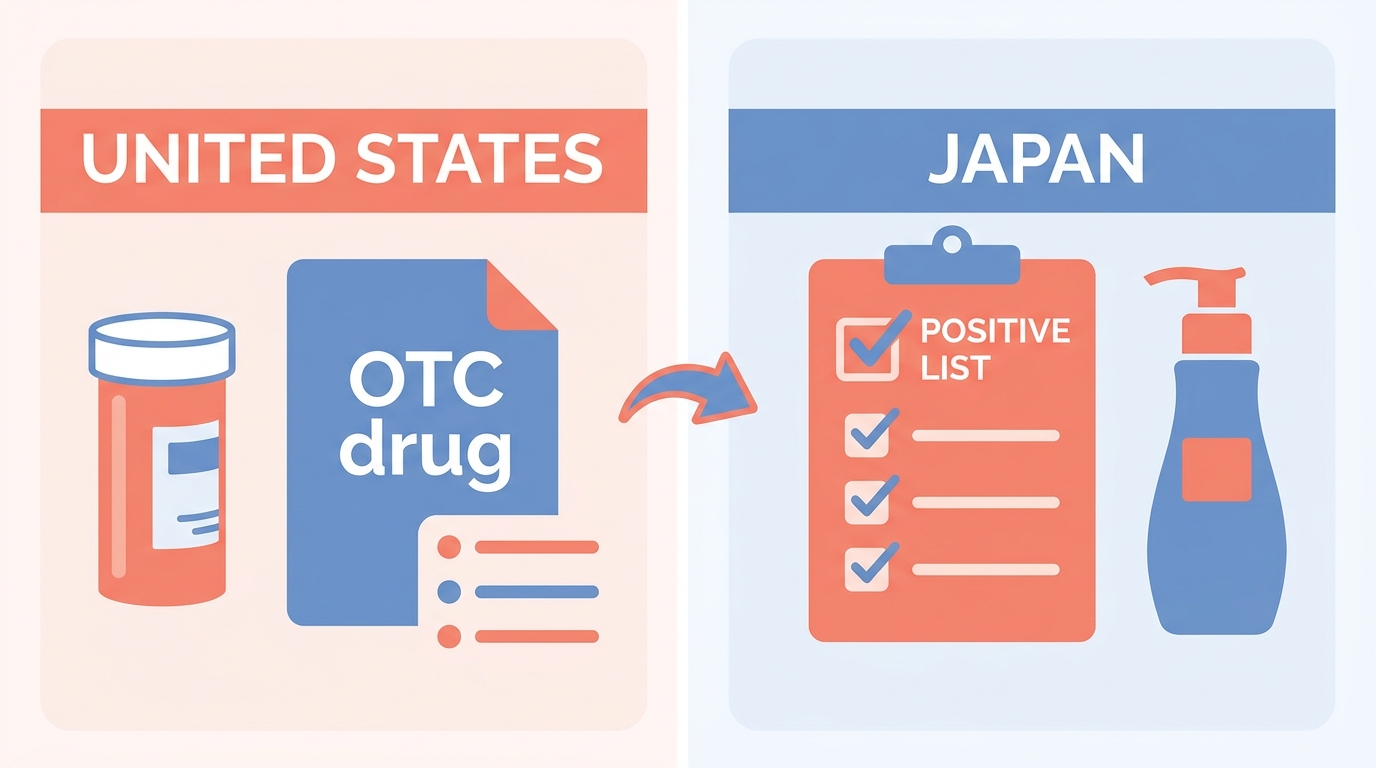
Japanese and American sunscreens are not built on different science. They are built under different rules.
- In the US, sunscreen is regulated as an over-the-counter (OTC) drug. Every active ingredient has to fit the FDA’s sunscreen monograph, and adding a new one has historically been slow.
- In Japan, most sunscreens are regulated as cosmetics (some are “quasi-drugs”). UV filters must come from a government list with maximum concentrations, but formulators can choose freely within that list.
- The result: Japanese brands have had access to a wider range of modern UV filters for years, which makes light, comfortable textures easier to achieve — especially for UVA protection.
That does not make American sunscreen unsafe or useless. It means the toolbox is different.
Why the US has had fewer sunscreen filters
Because the US treats sunscreen as a drug, the question for each active ingredient is whether it is “generally recognized as safe and effective” (GRASE) under the OTC monograph.
In 2019, the FDA proposed an update that reviewed 16 active ingredients. Only two — zinc oxide and titanium dioxide — were proposed as GRASE. For twelve others, including avobenzone and oxybenzone, the FDA said it did not yet have enough safety data and asked manufacturers for more. Those ingredients were not banned; they stayed on the market while the data question remained open.
That is the background to the line you may have read many times: “The US hasn’t approved a new sunscreen filter since the 1990s.”
That line is now out of date. In December 2025, the FDA proposed adding bemotrizinol — a broad-spectrum filter that has been used for years in Japan, Europe and elsewhere — to the US monograph at up to 6%. The final order was issued on June 10, 2026 and took effect on August 9, 2026. It is the first new sunscreen active added in the US in roughly a quarter of a century.
It will still take time before American products using it are common. But the gap is starting to close.
How Japan regulates sunscreen — and why it matters
In Japan, cosmetics are governed by the Cosmetic Standards issued by the Ministry of Health, Labour and Welfare. UV absorbers are on a positive list: a filter can be used only if it appears on that list, and only up to its listed maximum.
Within that list, a brand does not need a separate drug-style review for each new product. In practice, that lets Japanese formulators:
- combine several modern filters to cover both UVB and UVA,
- choose oil-soluble filters that dissolve cleanly instead of leaving residue,
- iterate on textures (gels, milks, essences) every season.
I want to be careful here: this is not “Japan has looser rules.” Both systems are designed around safety. They simply draw the line in different places — the US at the individual-ingredient drug review, Japan at a fixed list of permitted filters and limits.
Reading a Japanese sunscreen label: SPF, PA and ★
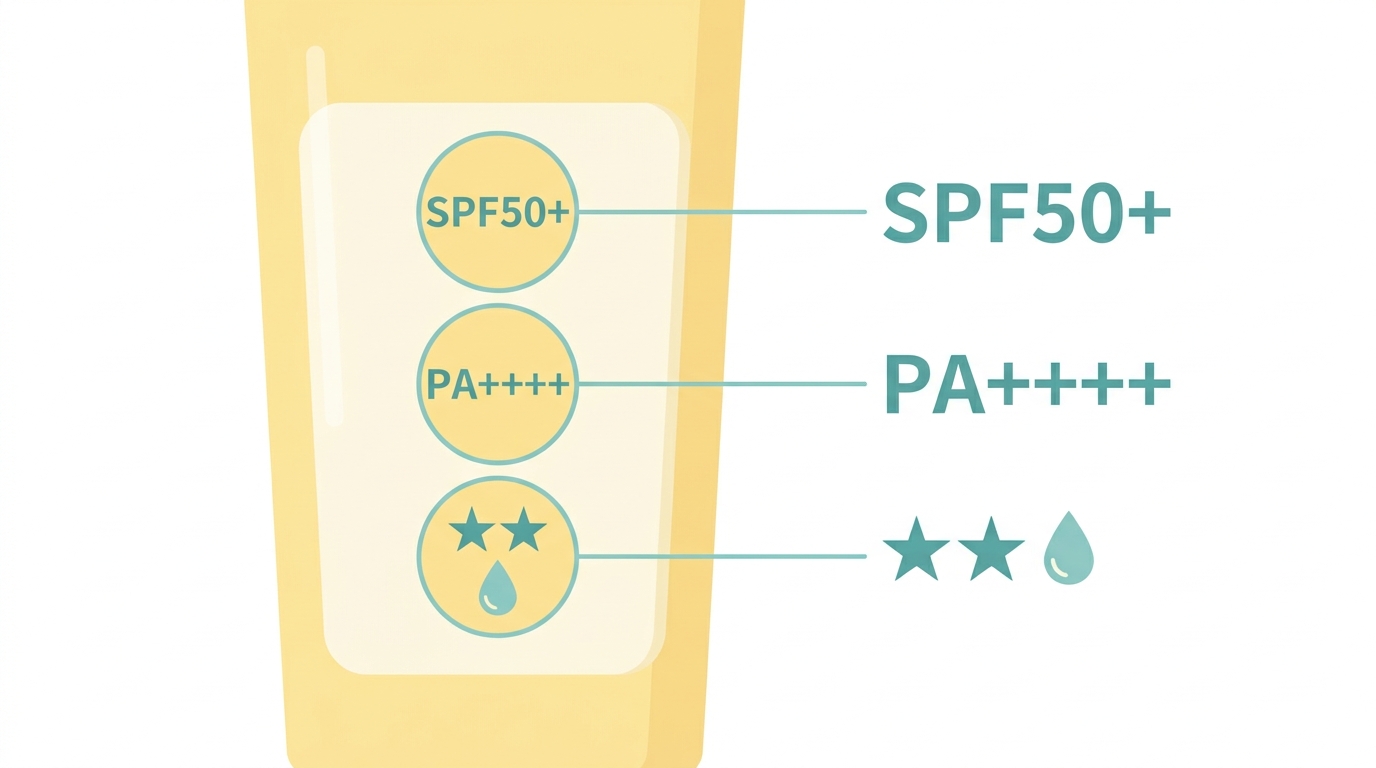
Japanese labels carry more information about UVA than you might be used to.
| Label | What it means | Notes |
|---|---|---|
| SPF | Protection against UVB (sunburn) | Japan caps the label at SPF50+. Anything that tests at 50 or above is shown as “50+”. |
| PA+ to PA++++ | Protection against UVA (the rays linked to skin aging) | A Japanese industry grading. PA++++ has been allowed since January 2013, after the measurement standard was revised in line with ISO. |
| UV water resistance ★ / ★★ | How well protection holds up after time in water | An industry standard based on ISO 18861, introduced in December 2022. To qualify, the product must keep at least 50% of its SPF after 40 minutes (★) or 80 minutes (★★) in a water bath. |
How does that compare with the US?
| Japan | United States |
|---|---|
| SPF50+ (cap on the label) | SPF number as tested |
| PA+ to PA++++ (graded UVA) | “Broad Spectrum” — a pass/fail test (critical wavelength of at least 370 nm) |
| UV water resistance ★ / ★★ | “Water Resistant (40 minutes)” or “(80 minutes)” |
The biggest practical difference is UVA. A US “Broad Spectrum” label tells you the product passed a threshold. A Japanese PA rating tells you roughly how much UVA protection you are getting.
Why Japanese sunscreens feel so different on the skin
From the formulation side, a few general factors explain most of the texture gap:
- More filter options. When you can mix several efficient filters, you need less of each one, which leaves more room in the formula for lightweight ingredients.
- Oil-soluble filters that disappear. Many newer filters dissolve well in light oils, so the finish is clear instead of chalky.
- Water-based formats. Gels, milks and “essence” textures are very popular in Japan, where sunscreen is treated as an everyday step under makeup rather than a beach product.
- Fine dispersion of mineral filters. Zinc oxide and titanium dioxide can be milled and dispersed so they leave far less white cast.
- Designed to wash off easily. Many everyday Japanese sunscreens are designed to come off with regular face wash or soap, because people wear them daily and don’t want heavy cleansing every night. Water-resistant formulas are a separate category.
None of these are secret technologies. They are design priorities shaped by the rules and by how people in Japan actually use sunscreen.
So, is Japanese sunscreen “better”? A formulator’s honest take
Where Japanese sunscreen often has an edge
- More detailed UVA labeling (PA grades)
- Comfortable textures that make daily use easier — and the best sunscreen is the one you actually wear every day
- A large range of formats for different skin types and situations
What to keep in mind
- Products bought for import are made for the Japanese market and labeled for Japanese rules, not the FDA’s.
- Buy from reliable sellers. Popular Japanese sunscreens are sometimes sold through unofficial channels, and counterfeits exist.
- For swimming or heavy sweating, look specifically for the ★ / ★★ water resistance mark — not every Japanese sunscreen is built for that.
- Whether a product suits your skin is individual. If you have sensitive skin or a skin condition, talk to a dermatologist.
So: Japanese sunscreen is not magic, and American sunscreen is not inferior by default. Japanese products have simply had a wider, more modern toolbox for longer — and that shows up most clearly in texture and UVA labeling.
How to choose one: a quick checklist
- Daily commute or office: SPF30–50+, PA+++ or higher, a light gel or milk you will happily reapply.
- Outdoor sports or beach: SPF50+, PA++++, and UV water resistance ★★.
- Sensitive skin: consider mineral-only formulas (often labeled “non-chemical” in Japan), and patch-test first.
- Under makeup: a thin essence or gel type that sets without pilling.
If you want to compare what is available outside Japan, you can browse Japanese sunscreens on Amazon.
Shopping in Japan? See What to Buy at a Japanese Drugstore for label tips and the November 2026 tax-free change, and Why Do Japanese Eye Drops Feel So Cool? for another Japanese drugstore favorite.
FAQ
Can I legally buy Japanese sunscreen in the US? People do buy them for personal use through online retailers. Keep in mind these products are made for the Japanese market and are not reviewed as US OTC drugs.
Why don’t American brands just use the same filters? Because in the US each sunscreen active must be covered by the FDA monograph. Until bemotrizinol was added in 2026, many filters common in Japan and Europe simply weren’t available to US brands.
Is PA the same as “broad spectrum”? Not exactly. “Broad Spectrum” in the US is a pass/fail threshold. PA is a graded scale, so it tells you more about how much UVA protection a product offers.
Do I need a special cleanser for Japanese sunscreen? It depends on the product. Many daily-use Japanese sunscreens are made to come off with ordinary face wash, while water-resistant ones usually need a more thorough cleanse. Check the package instructions.
This article explains regulations and general formulation principles. It is not medical advice and does not make claims about any specific product.
Sources
- FDA proposed rule, Sunscreen Drug Products for OTC Human Use (2019): https://www.federalregister.gov/documents/2019/02/26/2019-03019/sunscreen-drug-products-for-over-the-counter-human-use
- Federal Register, proposed order to add bemotrizinol (Dec 12, 2025): https://www.federalregister.gov/documents/2025/12/12/2025-22649/amending-over-the-counter-monograph-m020-sunscreen-drug-products-for-over-the-counter-human-use
- AFS, final order on bemotrizinol (June 2026): https://www.afslaw.com/perspectives/alerts/here-comes-the-sunscreen-fda-greenlights-bemotrizinol-active-ingredient
- FDA, Labeling and Effectiveness Testing (broad spectrum / water resistance): https://www.fda.gov/regulatory-information/search-fda-guidance-documents/labeling-and-effectiveness-testing-sunscreen-drug-products-over-counter-human-use-small-entity
- MHLW, Cosmetic Standards (Notification No. 331): https://www.mhlw.go.jp/content/000491511.pdf
- JCIA, PA++++ and revised UV measurement standard (2012 release): https://www.jcia.org/user/common/download/approach/news_release/JCIA_release20121114-UV-PF.pdf
- JCIA, UV water resistance standard: https://www.jcia.org/user/business/guideline/taisui