Japanese drugstores are one of the most popular stops for visitors. Data from a shopping app used by inbound travelers shows that cosmetics, eye drops, pain-relief patches and supplements are among the most-searched items when tourists shop in Japan.
Most “what to buy” lists online give you twenty product names. This guide does something different. I develop cosmetics in Japan, so I will not recommend specific brands — that would not be fair or neutral coming from someone inside the industry. Instead, I will show you which categories are genuinely different from what you can buy at home, how to read the labels, and how to make tax-free shopping work — including the big change on November 1, 2026.
Where to shop
You will see drugstores everywhere in Japanese cities: large chains on shopping streets and station buildings, and discount stores that sell cosmetics and medicine alongside snacks and souvenirs.
- Big drugstore chains have the widest cosmetics and OTC medicine selection, and many have staff who can help in English or with translation tablets.
- Discount variety stores are open late and are convenient for one-stop shopping, but the medicine section can be smaller.
- Pharmacist hours matter. Some stronger OTC medicines can only be sold while a pharmacist is on duty. If you need medicine, go during the day.
The categories worth your suitcase space
1. Sunscreen
This is the category where Japan is most different from the US and many other countries. Japanese sunscreens are typically light gels, milks and essences, and their labels grade UVA protection with PA+ to PA++++. Look for ★ or ★★ if you need water resistance for swimming or sports.
If you want the full explanation of why they feel so different, I wrote about it here: Is Japanese Sunscreen Better Than American?
2. Skincare “lotion” (it’s not what you think)
In Japan, “lotion” (化粧水, keshōsui) usually means a watery toner applied after cleansing — not a body cream. The thicker step after it is often called “milk” (乳液, nyūeki), an emulsion.
Reading tip: products labeled “薬用” (yakuyō, medicated) are “quasi-drugs” in Japan. They contain an approved active ingredient and can make specific claims that ordinary cosmetics cannot. It does not automatically mean “stronger” — it means a different legal category.
3. Eye drops
Japanese eye drops are famous for their cooling kick, and many combine several ingredients in one bottle. They are OTC drugs, so read the box carefully: check whether they are OK with contact lenses, and start with a mild cooling level. More on that here: Why Do Japanese Eye Drops Feel So Cool?
4. Pain-relief patches
Cooling and warming patches for sore shoulders and backs are a staple in Japanese households and a popular souvenir. These are medicines too — follow the directions on the box, and check the rules for bringing medicine into your home country.
5. Budget makeup
Drugstore makeup in Japan is affordable and changes quickly, with lots of seasonal and limited-edition items. It is a good category for trying something new without spending much. Testers are usually available — use the provided applicators.
6. Small extras that pack well
Lip balms, hand creams, cleansing sheets, oral-care items and travel-size skincare are light, cheap and easy to fit around bigger purchases.
How to read a Japanese drugstore label quickly
| What you see | What it means |
|---|---|
| 化粧水 | “Lotion” — a watery toner |
| 乳液 | “Milk” — a light emulsion |
| 美容液 | “Essence” or serum |
| 日焼け止め | Sunscreen |
| 薬用 / 医薬部外品 | Quasi-drug (medicated cosmetic with an approved active ingredient) |
| 第1類 / 第2類 / 第3類医薬品 | OTC medicine classes; Class 1 needs a pharmacist |
| SPF50+ / PA++++ | Highest sun-protection labels used in Japan |
| 無香料 | Fragrance-free |
A translation app’s camera mode handles most of the rest.
Tax-free shopping: what changes on November 1, 2026
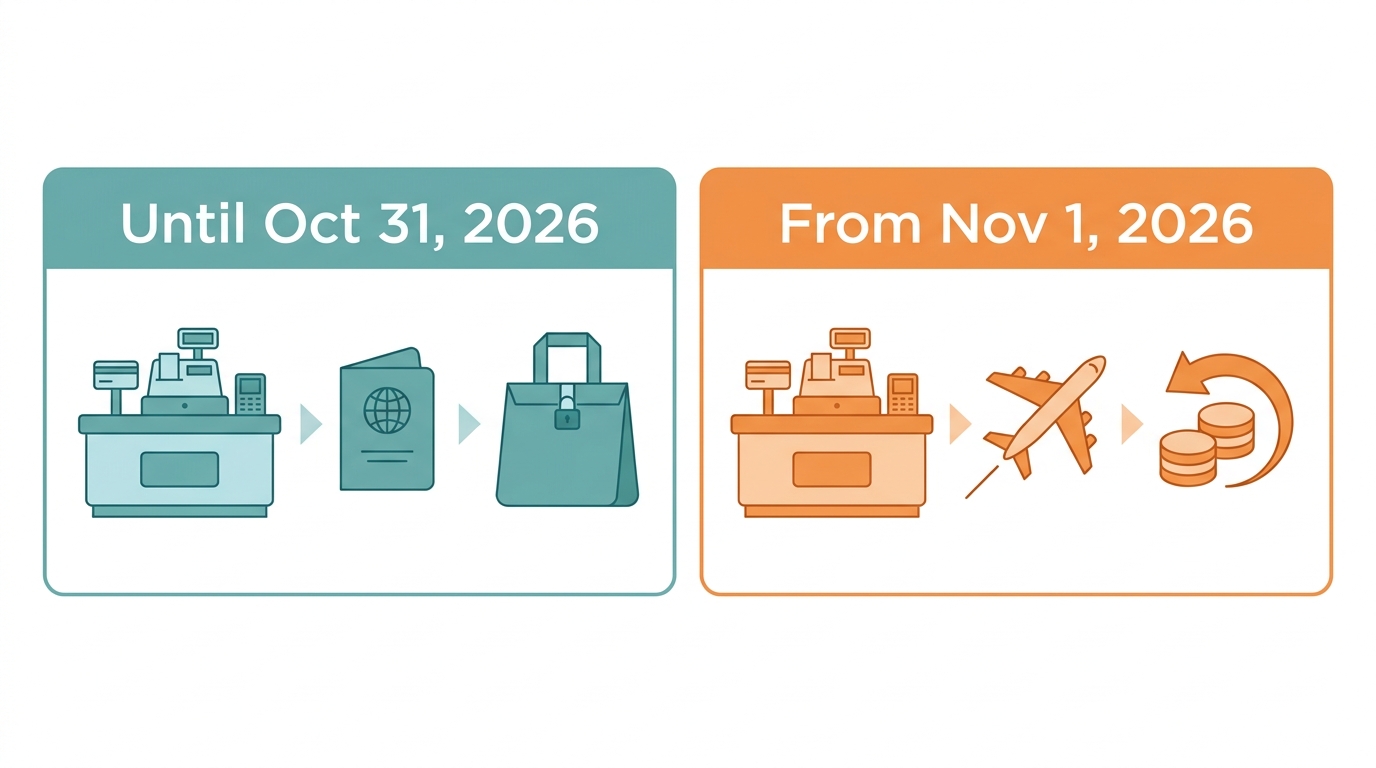
Japan exempts eligible purchases by short-term visitors from the 10% consumption tax (8% for some items), as long as the goods are taken out of Japan. The system is being reformed.
Until October 31, 2026 (current system)
- Show your passport at a tax-free store and pay the tax-free price at the register (or get the tax back at the store’s counter).
- Consumables such as cosmetics, medicine and food are sealed in a special bag that you should not open until you leave Japan.
- Consumables have a minimum of ¥5,000 and an upper limit per store per day.
From November 1, 2026 (new refund system)
- You pay the normal tax-inclusive price at the store.
- When you leave Japan, customs confirms you are taking the goods out, and the tax is refunded afterward by the method you chose (for example, to a credit card or bank account). Refunds can take days to weeks.
- The split between “general goods” and “consumables” and the sealed-bag requirement are abolished, as is the upper limit for consumables.
- The ¥5,000 minimum (same store, same day) still applies.
- You still must not use up the items in Japan — they have to leave the country with you to qualify.
Practical tips:
- Keep your receipts and the store’s tax-free records together.
- Leave enough time at the airport for the customs check.
- Pack tax-free items where you can reach them in case customs asks to see them.
Rules and procedures can be updated, so check the official Japan Tax-free Shop information before your trip.
Before you fly home
- Liquids in carry-on bags are limited by airport security rules, so large sunscreens and lotions usually go in checked luggage.
- Medicine rules differ by country. Some OTC medicines sold freely in Japan may be restricted where you live. Check your country’s customs or health authority before bringing them home.
- Buy what you will use. Cosmetics and medicine have expiry dates, and stocking up on ten bottles of something you have never tried is a common regret.
FAQ
Can I return or exchange drugstore items? Generally not once opened, and tax-free items have extra conditions. Check with the store at the time of purchase.
Do Japanese drugstores take credit cards? Large chains usually accept major cards and many cashless payments, but smaller shops may not. Carry some cash as a backup.
Is “medicated” (薬用) skincare stronger? Not necessarily. It means the product is a quasi-drug with an approved active ingredient and specific permitted claims. Pick based on your skin and needs, not the label alone.
What if I need medicine for a specific symptom? Ask the pharmacist at the drugstore. If you have an existing condition, are pregnant, or are buying for a child, talk to a pharmacist before buying.
This guide explains product categories, labels and procedures. It is not medical advice and does not recommend specific products.
Sources
- National Tax Agency, revision of the tax-free shop system to a refund method: https://www.nta.go.jp/publication/pamph/shohi/menzei/201805/format/002.htm
- Japan Tourism Agency, Japan Tax-free Shop information: https://www.mlit.go.jp/kankocho/tax-free/page01_000001_00019.html
- japan-guide.com, Japan’s tax-free shopping rules change from November 2026: https://www.japan-guide.com/news/tax-free-shopping.html
- Payke press release on inbound visitors’ product search rankings (Nov 2024–Jan 2025, PR TIMES): https://prtimes.jp/main/html/rd/p/000000040.000022289.html