

If you have ever tried a Japanese eye drop after a regular one from home, you probably remember the moment: a sharp, icy rush, watery eyes for a few seconds, then a “wide awake” feeling. Some people love it. Others are shocked and ask whether it is supposed to burn.
I work in product development on the cosmetics side in Japan, not as a doctor or pharmacist. So this article does not tell you which eye drop to use. It explains what creates that sensation, why the products are built so differently from American ones, and what to check on the box.
The short answer
- The cooling kick usually comes from cooling agents such as menthol or camphor added to the formula.
- Menthol does not lower the temperature of your eye. It switches on the nerve sensor that normally detects cold, so your brain reads it as “cold.”
- Japanese OTC eye drops are allowed to combine many kinds of ingredients in one bottle, and refreshing sensation is a big selling point in Japan. US OTC eye drops are built around a much shorter list of active-ingredient types.
- A strong cooling feeling is not the same thing as a stronger medicine. If drops hurt, cause lasting redness, or affect your vision, stop and talk to a pharmacist or doctor.
What makes eye drops feel cold: menthol and the “cold sensor”
Your eye’s surface is packed with nerve endings. One of the sensors on those nerves is a protein called TRPM8, which responds to cold temperatures.
Menthol binds to TRPM8 and opens it the same way a drop in temperature would. Nothing actually gets colder; the nerve just sends a “cold” signal. That is the same reason mint gum feels cold in your mouth.
Researchers have studied TRPM8 in the eye partly because the cold-sensing nerves seem to play a role in tear production. A small clinical trial found that exposing the eye surface to menthol vapor increased tear secretion without being reported as irritating. That is research on a mechanism — it is not evidence that any particular eye drop treats dry eye.
Why it can sting
“Cool” and “sting” are close neighbors for your nerves.
- Concentration and personal sensitivity. The same amount of cooling agent can feel pleasantly fresh to one person and painful to another. Tired or dry eyes often feel it more.
- Several ingredients at once. Many Japanese eye drops contain a mix of ingredients, and some of them can make the first second feel sharper.
- It is designed to be noticed. In Japan, a strong “refreshing” kick is part of the appeal. Some brands even print a cooling-strength scale on the box so shoppers can pick a mild or an intense one.
A brief tingle that fades within a few seconds is what these products are designed to do. Pain that lasts, redness that gets worse, or blurred vision is not something to push through — stop using the product and ask a professional.
Japan vs. the US: different rules, different bottles
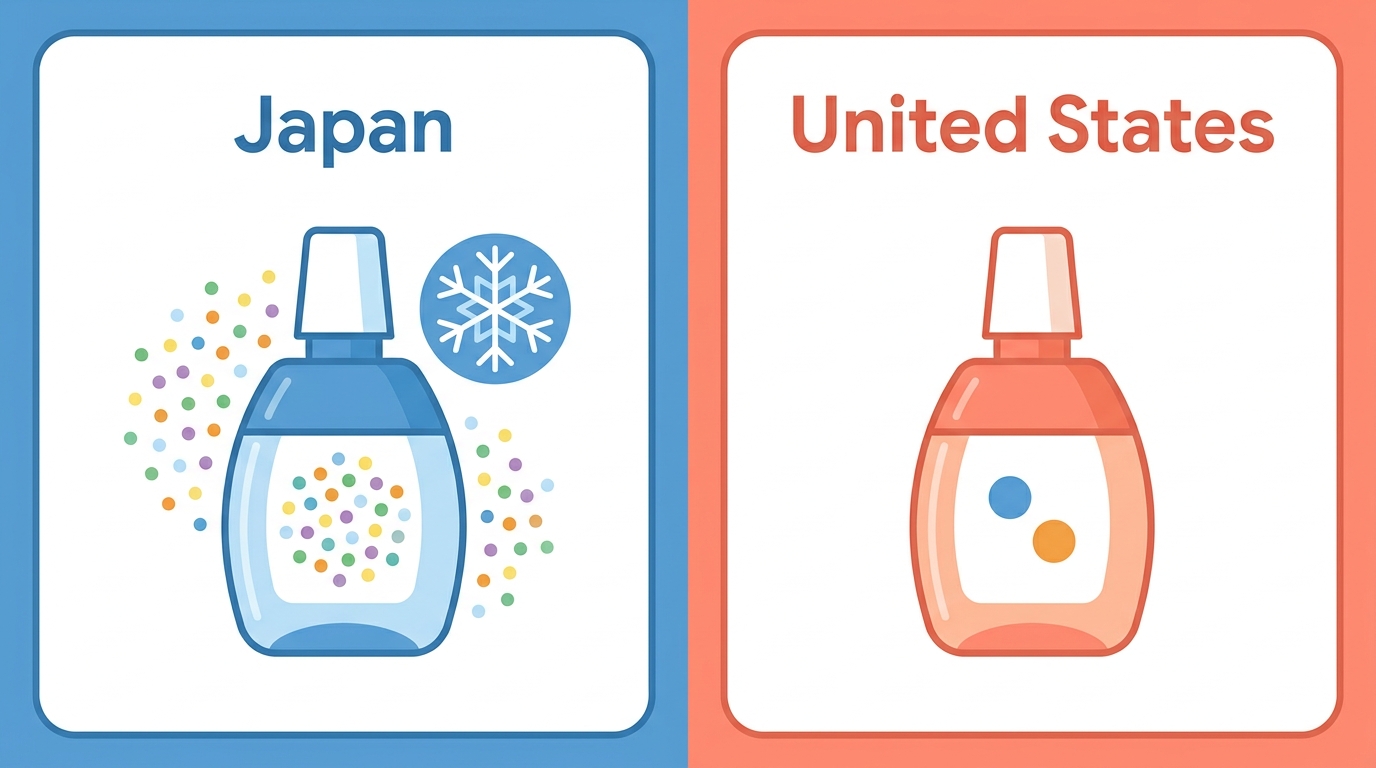
Both countries regulate OTC eye drops as drugs, but the frameworks are built differently.
| Japan (OTC eye drops) | United States (OTC eye drops) | |
|---|---|---|
| Framework | Approval standards for OTC ophthalmic products (MHLW, 1986) | FDA OTC monograph for ophthalmic drug products (21 CFR Part 349 / Monograph M018) |
| Active-ingredient categories | Many: vasoconstrictors, anti-inflammatory agents, antihistamines, vitamins and nutrients, amino acids, antibacterials, artificial-tear components and more | A short list: astringents, demulcents (lubricants), emollients, vasoconstrictors, and eyewashes |
| Typical product | Multi-ingredient formulas (for example, a vasoconstrictor plus vitamins plus amino acids) with a cooling agent added for sensation | Simpler formulas built around one purpose, such as lubricating or reducing redness |
In Japan, cooling agents like menthol are generally used as additives for sensation, not as the medicine itself; they are not among the active-ingredient categories in the approval standard. That is why the cooling strength can vary so much between products without changing what the box says the product is for.
The ingredient to know about: redness relievers
Both Japanese and American eye drops can contain vasoconstrictors — ingredients such as tetrahydrozoline or naphazoline that narrow blood vessels to make eyes look less red.
The US label rules for these ingredients include a warning that overuse may produce increased redness of the eye. That is worth knowing whichever country your drops come from. If you find yourself needing redness drops every day, that is a reason to talk to an eye doctor, not to buy a stronger bottle.
Before you use Japanese eye drops: a checklist
- Check whether it is OK with contact lenses. Many Japanese drops say clearly on the box whether they can be used with lenses in. If it does not say so, assume not.
- Look at the ingredient list. Note whether it contains a vasoconstrictor if you only want lubrication.
- Start mild. If the box shows a cooling-strength scale, pick a lower number first.
- Pregnancy, children, eye conditions, or prescription eye medicine: ask a pharmacist or doctor before using any OTC eye drop, Japanese or not.
- Buy from reliable sellers. Popular Japanese eye drops are widely resold online, and you want an unopened, in-date product.
If you are in Japan, pharmacists at drugstores can help you choose. Outside Japan, you can see what is sold internationally by browsing Japanese eye drops on Amazon.
Buying other medicine in Japan? See Buying Medicine in Japan for OTC classes and the 2026 purchase limits, and What to Buy at a Japanese Drugstore for everything else.
FAQ
Are Japanese eye drops safe? They are regulated OTC drugs in Japan, but “safe” always depends on the person and how the product is used. Follow the directions on the box, and talk to a pharmacist or doctor if you have an eye condition, wear lenses, are pregnant, or are buying for a child.
Why are Japanese eye drops minty? Because many contain cooling agents such as menthol, which trigger the eye’s cold-sensing nerves. The mint smell and the cold feeling come from the same kind of ingredient.
Is a stronger cooling feeling a sign of a stronger medicine? No. The cooling sensation and the active ingredients are separate things. A very cool drop is not necessarily more effective, and a mild one is not necessarily weaker.
Why don’t American eye drops feel like this? US OTC eye drops are built around a shorter list of active-ingredient types and tend to focus on one job, such as lubricating or reducing redness. A strong cooling kick simply isn’t the selling point there that it is in Japan.
This article explains how ingredients and regulations work. It is not medical advice. For eye pain, persistent redness, or vision changes, see an eye doctor.
Sources
- MHLW, approval standards for OTC ophthalmic products (Notification No. 623, July 29, 1986): https://www.mhlw.go.jp/web/t_doc?dataId=00ta7077&dataType=1&pageNo=1
- eCFR, 21 CFR Part 349 — Ophthalmic Drug Products for OTC Human Use: https://www.ecfr.gov/current/title-21/chapter-I/subchapter-D/part-349
- 21 CFR 349.75 — labeling of ophthalmic vasoconstrictors (“Overuse of this product may produce increased redness of the eye”): https://www.law.cornell.edu/cfr/text/21/349.75
- FDA, OTC Monograph M018 (Ophthalmic Drug Products): https://www.accessdata.fda.gov/drugsatfda_docs/omuf/monographs/OTC%20Monograph_M018-Ophthalmic%20Drug%20Products%20for%20OTC%20Human%20Use%2004.04.22.pdf
- Molecular mechanisms underlying menthol binding and activation of TRPM8 (PMC): https://www.ncbi.nlm.nih.gov/pmc/articles/PMC7391767/
- TRPM8 Channels and Dry Eye (PMC): https://pmc.ncbi.nlm.nih.gov/articles/PMC6316058/
- Acute tear secretion response to menthol delivered as a vapor to the eye — randomized clinical trial (PMC): https://pmc.ncbi.nlm.nih.gov/articles/PMC13516096/